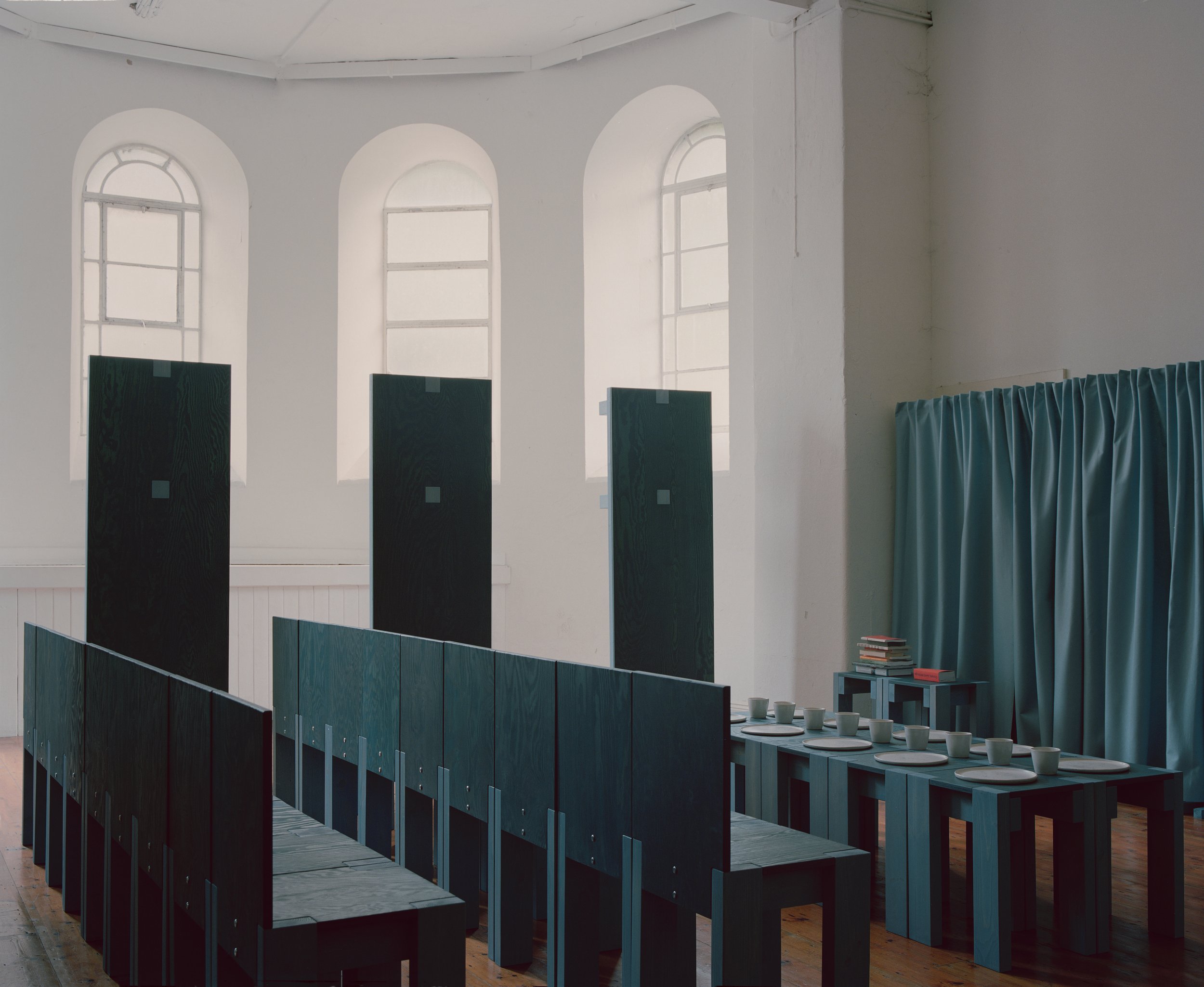
settle is a provocation to reimagine the public interior as a catalyst for collective experience within the modern city. Hannah Arendt spoke of the dangers of an entirely private life – and the importance of being related to and separated from others through the intermediary of ‘a common world of things’.
We see the public interior as a critical element of this world. settle is a reaction against modern capitalist structures which prioritise the individual above all else – devaluing the collective spaces human beings inhabit together. With our lives increasingly occupying the digital commons, the tangibility of considered, dignified, and situated public rooms is an increasingly rare phenomenon within daily life.
With this in mind, settle proposes an architecture of civic interiority. It explores ideas of the prototypical public interior that interest us – spatial order, threshold, material character, repetition and variation – and tests how these can be generated through a moveable material arrangement of objects and gestures.
In the context of a climate emergency, we consider it imperative to reuse buildings that already exist. We wish to explore how an infrastructure of considered and functional objects can formulate a new, albeit temporary, public interior that invites occupation and use.
Active form
We were drawn to the ingenious furnishings of Irish rural domestic interiors. Borne of harsh economic realities – furniture elements were conceived as functional and adaptable objects which were rarely used for a single purpose.
Some examples include falling tables, which were hinged to adjacent walls, and dressers used to divide space. Characterful settle beds - ‘Upright, rudimentary, unshiftably planked’, in Heaney’s words - were used interchangeably as storage, sleeping or seating elements. JM Synge observed that these objects ‘seem to exist as a natural link between the people and the world that is about them’.
Made of locally sourced and elementally assembled materials, these highly coloured objects derive their character from the legibility of their construction, animated presence, and thin surfaces of paint. They represent to us a distinctly Irish sensibility that is a useful counterpoint to the commodified emptiness of strategic vacancy and speculative development in modern Ireland.
In Yaneva’s reading of Latour, architecture is not simply a collection of materials gathered together, but instead an ‘active mediator, or active form, capable of translating, modifying, and crafting new social relations, re-shaping relational dynamics between groups, and acting as effective agents of societies and cultures’.
The Blue Room
Given the transient nature of the installation, it is required to respond to a number of different settings, the majority unknown at the time of conception. In this way, it requires the capacity to hold its character, to define a distinctive spatial experience within an unknowable set of contexts.
We had been researching the history of the salon - a space of conversation and discourse - during the early stage of the project. We were drawn to Richard Sennett’s description of Catherine de Rambouillet’s retreat from the 17th century Parisian court to her own house. The ‘blue room’ helped us to situate settle within a continuum of similar spaces, and to define its architectural character.
‘she made the civility of friends come alive in her Blue Room, a chamber historians think to be the model for the later salon as a social institution...She built a dwelling with stairs at the side, making as much room as possible for tall, airy rooms with light flooding in from opposite ends…the most important room in the house should be its most intimate, the Blue Room, in which, stretched out on a daybed she received guests. They also perched on the daybed or stood in the narrow strip between bed and wall, the ruelle, a sort of internal alley, crowded with visitors. The blue - walls, bedspread and curtains - broke with the dull tans and red of court interiors, a blue watered with abundant window light’.
(Richard Sennett, Together)
Daily encounters
David Leatherbarrow asserts that ‘architectural settings are preparations, readied through design, construction and repeated use to respond to the likely actions of everyday life and the ambient environment’.
Notable civic interiors, including banks, assembly rooms and market halls, have specific and situated qualities that relate to their function. Typically, they are ‘readied’ in their staging and materiality for repeatable daily gestures to unfurl within and around them.
In an increasingly secular and online world, the delight to be found in these interiors is increasingly rare. settle proposes a family of related but characterful furniture forms which serve the rituals of daily life, while responding to the complex spatial and functional requirements of a new public interior.
We acknowledge the limitations of this proposition though, as Bruno Latour notes ‘it would be wrong to assume that objects determine action; they simply allow, afford, encourage, authorise, suggest, influence, render possible’. However, settle extends an invitation to the city by prompting opportunities for collective gathering, alongside the possibility for intimacy within a public setting. In this way, we hope to celebrate the importance of collective civic life in the contemporary city.